
You’ve probably heard it before: “Time in the market, not timing the market.” It’s a phrase tossed around in investment circles so frequently it can almost become background noise. But have you truly understood what it means? Beyond the catchy slogan, lies a profound investment concept that can significantly shape your financial future. This isn’t about predicting the unpredictable, but about harnessing a powerful, albeit abstract, force: time. It’s about recognizing that your investment journey is a marathon, not a sprint, and that patience, coupled with a well-defined strategy, can be your greatest ally.
The allure of timing the market is undeniable. Imagine being able to buy at the absolute bottom of a market dip and sell at the peak of a bull run. It sounds like the ultimate investment hack, a guaranteed path to riches. But let’s be honest with yourself: are you an oracle? Do you possess a crystal ball that can accurately predict the future movements of billions of dollars influenced by a complex web of economic, political, and social factors? The harsh reality is that very few, if any, investors can consistently and successfully time the market.
The Futility of Prediction
Think about the sheer volume of information that influences market movements. News headlines, geopolitical events, company earnings reports, central bank decisions, even natural disasters – all these factors, and countless more, can send markets soaring or plunging with little to no warning. Trying to anticipate all of these and their precise impact on asset prices is akin to trying to predict the exact trajectory of every single raindrop in a storm. It’s a near-impossible task, and the pursuit of it often leads to costly mistakes.
Emotional Decision-Making
When you attempt to time the market, you often find yourself driven by emotions. Fear can grip you when you see a market downturn, compelling you to sell your investments prematurely, locking in losses. Conversely, greed can take hold during a bull market, pushing you to buy in at inflated prices, only to be caught when the market inevitably corrects. These emotional responses are the antithesis of rational, long-term investment strategy. You end up chasing trends, buying high and selling low – the exact opposite of what you should be doing.
Missed Opportunities
Even if, by some fluke, you manage to time a single market move correctly, the difficulty lies in replicating that success consistently. Each time you try to jump in and out of the market, you risk missing out on periods of significant growth. These periods, often short and sharp, can contribute a substantial portion to your overall returns. By being on the sidelines, waiting for the “perfect” entry point, you might be forfeiting the very gains you’re trying to capture.
The Role of Professional Investors
Consider the professionals – the hedge fund managers, the mutual fund advisors, the institutional investors who dedicate their careers and vast resources to market analysis. Even with their sophisticated tools, research teams, and insider knowledge, very few consistently outperform the market by timing it. Many struggle to beat simple index funds over the long term. If these titans of finance can’t reliably time the market, what hope do you, as an individual investor, have? It’s a sobering thought that underscores the inherent difficulty of this strategy.
Understanding the concept of “time in the market” is crucial for investors looking to build wealth over the long term. A related article that delves deeper into this topic can be found at How Wealth Grows, where you can explore strategies and insights on how staying invested can significantly impact your financial growth. This resource provides valuable information on the importance of patience and the benefits of compounding returns over time.
Time in the Market: The Power of Compounding
So, if timing the market is a fool’s errand, what is the alternative? This is where “time in the market” truly shines. It’s about embracing the inherent volatility of the market and allowing your investments to grow over extended periods, benefiting from the magic of compounding.
The Compounding Effect Explained
Compounding is often described as interest earning interest. When you invest, you earn returns on your initial principal. But with compounding, you also earn returns on the accumulated returns from previous periods. This creates an exponential growth curve over time, where your money starts working for you, generating even more money.
Simple vs. Compound Interest
Let’s illustrate with a simple example. Imagine you invest $1,000 at an annual interest rate of 10%.
- Simple Interest: After one year, you earn $100 ($1,000 x 10%). Your total is $1,100. After five years, you’d earn a total of $500 in interest ($100 per year x 5 years), bringing your total to $1,500.
- Compound Interest: After one year, you earn $100 ($1,000 x 10%). Your total is $1,100. In the second year, you earn 10% on $1,100, which is $110. Your total is now $1,210. In the third year, you earn 10% on $1,210, which is $121. Your total is $1,331. After five years, with compounding, your total would be approximately $1,610.
While the difference might seem small in this short example, over decades, the impact of compounding is truly staggering. The longer your money is invested, the more time it has to benefit from this snowball effect.
The Importance of Early Investment
The earlier you start investing, the more significant the impact of compounding will be. If you begin investing in your 20s, you have a substantial runway for your investments to grow and multiply. By the time you reach retirement, your initial contributions, amplified by decades of compounding, can become a substantial nest egg. Conversely, delaying your investments means you have less time for compounding to work its magic, requiring larger contributions later on to reach the same financial goals.
Riding Out Market Volatility
Markets will go up and down. This is an unavoidable truth. There will be periods of economic expansion and periods of recession. There will be bull markets that make you feel like a genius and bear markets that test your resolve. Time in the market allows you to weather these inevitable storms.
The Historical Performance of Equities
While past performance is not indicative of future results, historical data consistently shows that the stock market, over the long term, trends upwards. Despite numerous recessions, wars, and economic crises, the overall trajectory of major stock indices has been positive. This upward trend is a testament to the power of economic growth, innovation, and the ability of companies to adapt and thrive.
The Benefits of a Long-Term Perspective
When you have a long-term perspective, a temporary market dip becomes an opportunity rather than a disaster. You can view it as a chance to buy assets at a discount, knowing that historically, markets have recovered and continued to grow. This long-term view helps you avoid panic selling during downturns and allows you to stay invested through the ups and downs, ultimately capturing the market’s upward momentum.
What “Time in the Market” Actually Means for You

Understanding “time in the market” isn’t just an abstract concept; it has tangible implications for your investment strategy and your financial well-being. It’s about making informed decisions that align with your goals and your risk tolerance.
Your Investment Horizon Matters
Your investment horizon is the length of time you plan to keep your money invested. This is intrinsically linked to “time in the market.”
Short-Term vs. Long-Term Goals
If you have short-term goals, such as saving for a down payment on a house in two years, you wouldn’t typically invest that money in the stock market. The risk of market volatility would be too high. For short-term goals, you’d likely opt for lower-risk, lower-return investments like savings accounts or short-term bonds. However, for long-term goals, such as retirement planning, which could be 30 or 40 years away, a significant allocation to the stock market becomes not only appropriate but often necessary to achieve your objectives.
Building Wealth Gradually
The power of time in the market is about building wealth gradually. It’s about consistent contributions and allowing your investments to grow steadily over decades. It’s a disciplined approach that prioritizes steady progress over speculative gains. This gradual accumulation is what allows your investments to benefit fully from compounding and ride out market fluctuations.
The Importance of Diversification
While time in the market is crucial, it’s not the only factor. You must also ensure your investments are diversified.
Spreading Your Risk
Diversification means spreading your investment capital across various asset classes, industries, and geographies. The principle here is simple: don’t put all your eggs in one basket. If one sector or asset class performs poorly, others may perform well, helping to mitigate your overall losses.
Asset Allocation Strategy
Your asset allocation strategy – the mix of stocks, bonds, real estate, and other assets in your portfolio – is a critical component of managing risk and maximizing returns over time. A well-diversified portfolio, combined with a long-term investment horizon, allows you to participate in market growth while cushioning the impact of downturns.
The Role of Regular Contributions
“Time in the market” is amplified by consistent, regular contributions. This is often referred to as dollar-cost averaging.
Dollar-Cost Averaging (DCA)
Dollar-cost averaging involves investing a fixed amount of money at regular intervals, regardless of market conditions. When the market is high, your fixed amount buys fewer shares. When the market is low, your fixed amount buys more shares. This strategy helps you automatically buy more shares when prices are low and fewer shares when prices are high, potentially lowering your average cost per share over time. It also removes the emotional element of trying to time your purchases.
Building a Consistent Habit
Establishing a habit of regular investing, even small amounts, is more beneficial than waiting for a large sum to invest all at once. These consistent contributions, over time, are what truly allow you to benefit from being invested in the market for an extended period. You’re not just relying on the initial lump sum; you’re continuously adding to your investment and allowing the compounding process to work on a larger and larger base.
Practical Steps to Embrace “Time in the Market”

Understanding the concept is the first step; implementing it effectively is the next. Here’s how you can practically embrace “time in the market” in your investment journey.
Define Your Financial Goals
Before you invest a single dollar, you need to clearly define what you’re investing for and when you’ll need the money. This will dictate your investment horizon and your risk tolerance.
Retirement Planning
For most people, retirement is the longest-term financial goal. This typically means a significant portion of their investment portfolio should be allocated to growth assets like stocks, allowing for maximum benefit from compounding over several decades.
Other Long-Term Goals
Consider other long-term goals like saving for your children’s education or leaving a legacy. These also benefit from a long-term investment approach.
Choose the Right Investment Vehicles
The tools you use to invest matter. For most individual investors, low-cost, diversified index funds and exchange-traded funds (ETFs) are excellent choices for embracing “time in the market.”
Index Funds and ETFs
These funds track a specific market index (like the S&P 500) and offer instant diversification across a wide range of companies. They typically have very low expense ratios, meaning more of your investment returns stay in your pocket. By investing in an index fund, you’re essentially buying a small piece of the overall market and benefiting from its long-term growth.
Mutual Funds (Actively Managed)
While some actively managed mutual funds can perform well, their higher fees can eat into returns, and consistently outperforming the market over the long term is a significant challenge. For the average investor focused on “time in the market,” index funds often provide a more reliable and cost-effective route.
Stay Disciplined and Avoid Emotional Reactions
This is perhaps the most challenging, yet most crucial, aspect of embracing “time in the market.”
Develop an Investment Plan and Stick to It
Your investment plan should outline your goals, your asset allocation, and your rebalancing strategy. Treat it as your roadmap and resist the urge to deviate based on short-term market noise.
Ignore Short-Term Market Fluctuations
When the market experiences a downturn, remind yourself of your long-term strategy. Understand that volatility is normal and that selling in a panic will likely be detrimental to your returns. Focus on the historical evidence of market recovery.
Rebalance Periodically
Over time, the performance of different asset classes in your portfolio will shift. Rebalancing involves selling some of your overperforming assets and buying more of your underperforming assets to bring your portfolio back to your target asset allocation. This is a disciplined way to manage risk and can help you buy low and sell high in a systematic manner.
Understanding the concept of time in the market is crucial for investors looking to build wealth over the long term. A related article that delves deeper into this topic can be found at How Wealth Grows, where various strategies and insights are provided to help individuals navigate the complexities of investing. By focusing on the duration of their investments rather than trying to time the market, investors can potentially reap greater rewards.
The Psychological Advantage of Time in the Market
| Time in the Market Explained | |
|---|---|
| Definition | The concept of time in the market refers to the length of time an investor holds an investment, emphasizing the importance of staying invested for the long term. |
| Benefits | 1. Allows for compounding returns 2. Reduces the impact of market volatility 3. Provides the opportunity to ride out market downturns |
| Risks | 1. Potential opportunity cost of missing out on short-term gains 2. Exposure to market downturns if not properly diversified |
| Key Takeaway | Time in the market, rather than timing the market, is a fundamental principle for long-term investment success. |
Beyond the mathematical benefits of compounding and long-term growth, there’s a significant psychological advantage to embracing “time in the market.” It can lead to a more peaceful and less stressful investment experience.
Reduced Investment Stress
Constantly worrying about market movements and trying to predict the next big move can be incredibly stressful. By adopting a long-term perspective and focusing on time in the market, you can significantly reduce this anxiety. You’re less concerned with daily fluctuations and more focused on the overall journey.
Peace of Mind
Knowing that you have a well-thought-out plan and that you’re allowing your investments to grow steadily over time can bring a profound sense of peace of mind. You’re not constantly on edge, trying to outsmart the market; you’re simply letting the market do its work.
Building Patience and Discipline
The investment world often rewards patience and discipline. By committing to “time in the market,” you cultivate these essential qualities. You learn to resist impulsive decisions and to trust in the process of long-term wealth creation.
A Skill for Life
These aren’t just valuable traits for investing; they are valuable traits for life. Developing patience and discipline through your investment journey can positively impact other areas of your personal and professional life.
The Long Game Pays Off
Ultimately, “time in the market” is about recognizing that wealth creation is a marathon. It requires commitment, consistency, and a belief in the long-term potential of well-chosen assets. By understanding and embracing this fundamental investment concept, you position yourself for greater financial success and a more serene investment experience. You are not trying to be a market guru; you are simply being a patient investor, allowing the powerful forces of compounding and economic growth to work in your favor. The longer your money stays invested, the more it has the opportunity to grow, and the more likely you are to achieve your financial aspirations.
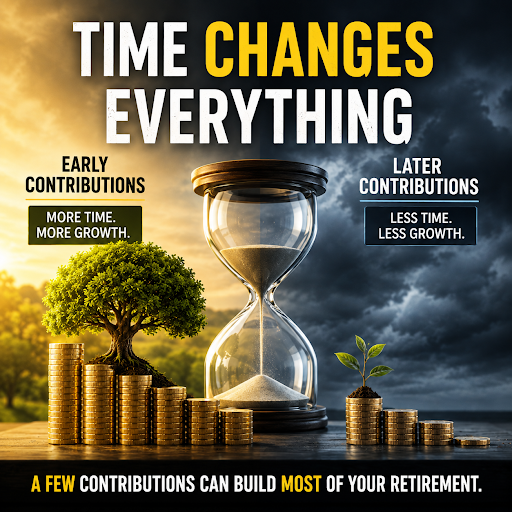
Only a Few 401(k) Contributions Build Most of Your Retirement
FAQs
What is “time in the market”?
“Time in the market” refers to the concept of staying invested in the stock market for a long period of time, rather than trying to time the market by buying and selling based on short-term fluctuations.
Why is “time in the market” important?
“Time in the market” is important because it allows investors to benefit from the long-term growth of the stock market. Studies have shown that staying invested over the long term tends to produce better returns than trying to time the market.
How does “time in the market” affect investment returns?
The longer an investor stays in the market, the more time their investments have to grow and compound. This can lead to significant returns over time, even if there are short-term market downturns.
What are the risks of trying to time the market?
Trying to time the market can be risky because it is difficult to predict short-term market movements. Investors who try to time the market may miss out on potential gains or sell at the wrong time, leading to losses.
How can investors benefit from “time in the market”?
Investors can benefit from “time in the market” by staying invested for the long term, remaining patient during market fluctuations, and focusing on their long-term investment goals. This approach can help investors capture the full potential of the stock market’s growth over time.