
You’re standing at the foot of a mountain. It looks impossibly high, its peak shrouded in clouds. You have a single pebble in your hand. It seems insignificant, a mere speck against the colossal challenge ahead. But what if that pebble, over time, could transform into a towering monument of your own creation? This is the essence of compounding, the silent architect of extraordinary wealth. You might feel like you’re starting small, perhaps with a meager savings account or a modest investment. But understand this: with patience and the magic of compounding, even the smallest beginnings can blossom into something truly remarkable.
Before you can wield the power of compounding, you need to grasp its core principles. Think of it like planting a seed. You don’t expect a fully grown tree overnight, do you? Compounding works in a similar fashion, but instead of sunlight and water, its fuel is your initial investment and the returns it generates.
Your Initial Investment: The Humble Beginning
Your starting point, that initial amount you set aside – whether it’s a few dollars saved from your weekly budget or a lump sum from a bonus – is the fertile ground for your wealth-building journey. It’s the seed you plant. The size of this initial seed matters, of course, but its true power lies in its ability to grow and reproduce.
The Magic of Reinvestment: The Germination Process
This is where the real magic happens. Compounding isn’t just about earning interest or returns on your initial investment. It’s about earning interest or returns on your interest and returns. Imagine your seed sprouts a small leaf. That leaf then helps the plant grow bigger, producing more leaves. In the world of finance, your initial investment earns a return. Then, the next period, you earn a return not just on your original investment, but also on the return you already earned. This process of reinvesting your earnings is the germinating force that propels your wealth forward.
The Power of Time: The Unfolding Seasons
Time is your greatest ally in the compounding game. The longer your money has to grow, the more pronounced the effect of compounding becomes. It’s like waiting for seasons to pass. A young sapling might not seem impressive in its first year, but as years turn into decades, it matures into a majestic tree. Similarly, your investment, given enough time, will experience exponential growth, far surpassing what simple interest could ever achieve.
Simple vs. Compound Interest: A Tale of Two Rivers
To truly appreciate the might of compounding, you need to understand its counterpart: simple interest. Simple interest is like a single, steady stream flowing into your pool of savings. It’s predictable and consistent. However, it only earns interest on your initial principal. Compound interest, on the other hand, is like a river that continually swells with tributaries. Each tributary is the interest you’ve already earned, which then begins to generate its own interest. The difference might seem subtle at first, but over long periods, it’s the difference between a modest stream and a raging, wealth-generating ocean.
Compounding is a powerful financial principle that can significantly enhance wealth over time, as highlighted in the article on how wealth grows. By reinvesting earnings and allowing interest to accumulate on both the principal and previously earned interest, individuals can witness exponential growth in their investments. For a deeper understanding of how compounding can build wealth, you can read more in this insightful article: How Wealth Grows.
The Snowball Effect: Accelerating Wealth Creation
As your investment grows through compounding, it gains momentum. This is often referred to as the “snowball effect.” Imagine rolling a small snowball down a snowy hill. Initially, it’s slow and gathers only a little snow. But as it picks up speed and size, it gathers snow exponentially, becoming a massive force. Your investments behave similarly.
Early Momentum: The Gentle Start
In the early stages of your investment journey, the impact of compounding might seem subtle. You might not see dramatic leaps in your net worth. This is normal. Think of the snowball at the top of the hill – it’s barely moving. The gains are primarily driven by your contributions and the initial interest earned. Don’t get discouraged; this is the crucial phase where you’re laying the foundation.
Mid-Journey Acceleration: The Gathering Pace
As your investment matures, the compounding effect begins to accelerate. The interest earned on your earnings starts contributing significantly to your overall growth. This is like the snowball picking up speed and size as it rolls further down the hill. Your returns begin to compound on themselves more rapidly, leading to more noticeable increases in your wealth.
The Exponential Leap: The Avalanche of Wealth
In the later stages of your investment horizon, the power of compounding truly comes into its own. The growth becomes exponential. Your earnings are generating substantial returns, and those returns are, in turn, generating even more returns. This is the snowball becoming an avalanche, a powerful, unstoppable force that can dramatically increase your wealth. This is where the seemingly small pebble you started with can indeed become a towering monument.
The Power of Consistent Contributions: Fueling the Snowball
While compounding is a powerful force on its own, it’s significantly amplified by consistent contributions. Think of it as adding more snow to your rolling snowball. The more you add, the bigger and faster it grows. Regularly investing even small amounts adds to your principal, providing more fuel for compounding to work its magic. This regular infusion of capital ensures that your snowball doesn’t just roll, but actively expands with every passing season.
The Time Factor: Your Most Valuable Asset

You’ve heard the adage, “time is money.” When it comes to compounding, this couldn’t be truer. Time isn’t just a duration; it’s the fertile ground where the seeds of your investment can mature and flourish.
The Early Bird Gets the Worm: The Advantage of Starting Young
If you’re young, you have an incredible advantage: time. The earlier you start investing, the more periods your money has to compound. Even small amounts invested in your 20s can grow to be significantly larger than larger amounts invested in your 40s, simply because of the extended compounding period. It’s like planting a tree when it’s a sapling versus planting it when it’s already a mature sapling. The former has decades more to grow into a mighty oak.
The Mid-Career Hustle: Closing the Gap
If you’re starting later in life, don’t despair. While you might not have the same extended timeframe as someone who started in their 20s, you can still harness the power of compounding by being more aggressive with your savings and investments. Your “mid-career hustle” can involve increased contributions and a more disciplined approach to maximizing your returns. Every extra dollar you contribute and every percentage point of return you gain becomes more critical in a shorter timeframe.
The Golden Years: Enjoying the Harvest
As you approach retirement, the fruits of your compounding efforts should become increasingly apparent. The substantial wealth you’ve built over the years can provide you with financial security and the freedom to enjoy your golden years. This is the culmination of your disciplined saving and investing, where the compounding has done its heavy lifting, allowing you to reap the rewards of your foresight and patience.
The Power of Consistency: Regular Nourishment
Just as a plant needs consistent watering and sunlight to thrive, your investment needs consistent contributions to maximize compounding. Making regular deposits into your investment accounts, whether it’s monthly or bi-weekly, ensures that your capital is always working for you and has more opportunities to generate returns. This regular nourishment is what keeps the compounding engine running smoothly and efficiently, preventing it from stagnating.
Strategic Approaches to Maximize Compounding

Understanding the mechanics of compounding is one thing; actively leveraging it is another. You need a strategy to ensure your money is working as hard as possible for you.
Investment Vehicles: Choosing the Right Soil
The type of investment you choose is akin to selecting the right soil for your seeds. Different investment vehicles offer different growth potentials and risk levels.
Stocks: The Potential for Explosive Growth
Investing in stocks, while carrying higher risk, offers the potential for significant returns over the long term. The growth of a company, its profits, and its stock price can all contribute to compounding your wealth at an accelerated pace. Think of it as planting in rich, fertile soil that allows for rapid and substantial growth.
Bonds: The Steady and Reliable Growth
Bonds generally offer lower returns than stocks but come with lower risk. They provide a more predictable income stream that can be reinvested, contributing to compounding. Bonds are like planting in well-tended, reliable soil, ensuring a steady and consistent harvest.
Real Estate: Tangible Assets with Potential Returns
Real estate can offer returns through rental income and property appreciation. The rental income can be reinvested, and the increasing value of the property adds to your overall wealth, creating a powerful compounding effect. This is like cultivating a mature orchard, where the fruits are harvested regularly and the land itself increases in value.
Mutual Funds and ETFs: Diversified Growth Opportunities
Mutual funds and Exchange-Traded Funds (ETFs) offer diversification by pooling money from many investors to buy a basket of securities. This allows you to benefit from the growth of multiple assets, spreading risk and providing opportunities for compounding across a diversified portfolio. They are like having a diverse garden, where different plants thrive under varying conditions, contributing to overall abundance.
Risk Tolerance: Understanding Your Comfort Zone
Your willingness to take on risk directly influences the types of investments you can comfortably make. Higher risk investments often have higher potential returns, which can accelerate compounding, but also come with a greater chance of loss. Understanding your risk tolerance is crucial for creating a sustainable and effective compounding strategy. It’s like choosing how much you’re willing to expose your delicate plants to the elements – too much and they wither, too little and they don’t grow as vigorously.
Diversification: Spreading Your Seeds
Don’t put all your eggs in one basket. Diversifying your investments across different asset classes, industries, and geographies helps mitigate risk. If one investment underperforms, others can compensate, ensuring your overall wealth continues to grow through compounding. This is like planting a variety of crops in different parts of your field; if one crop fails due to adverse conditions, others will still thrive, ensuring a harvest.
Compounding is a powerful financial principle that can significantly enhance your wealth over time, as it allows your investments to generate earnings on both the initial principal and the accumulated interest. For a deeper understanding of how this process works and its long-term benefits, you can explore a related article that delves into the intricacies of wealth accumulation through compounding. By reading more about this topic, you can gain valuable insights into effective investment strategies. Check out the article here: how wealth grows.
Overcoming Obstacles and Maintaining Momentum
| Year | Initial Investment | Annual Return | Ending Balance |
|---|---|---|---|
| 1 | 1000 | 10% | 1100 |
| 2 | 1100 | 10% | 1210 |
| 3 | 1210 | 10% | 1331 |
| 4 | 1331 | 10% | 1464.1 |
| 5 | 1464.1 | 10% | 1610.51 |
The path to building wealth through compounding isn’t always smooth. You’ll encounter challenges, but with perseverance and the right mindset, you can overcome them and maintain your momentum.
Inflation: The Silent Erosion of Purchasing Power
Inflation is the gradual increase in the general price of goods and services, which erodes the purchasing power of your money. If your investment returns don’t outpace inflation, your real wealth is actually decreasing. This is why aiming for investment returns that consistently beat inflation is crucial for true wealth building. It’s like trying to fill a bucket with a hole in it; you need to pour water in faster than it leaks out.
Market Volatility: Riding the Waves of Uncertainty
Financial markets are inherently volatile. Stock prices can fluctuate significantly, and economic downturns can impact investment values. It’s important to remember that market downturns are often temporary, and long-term investors can ride out these fluctuations. Panicking and selling during a downturn can be detrimental to your compounding strategy. It’s like navigating choppy seas; you need to stay the course, and the storm will eventually pass.
Behavioral Biases: The Psychological Pitfalls
Your own emotions can be your biggest enemy when it comes to investing. Fear during market dips and greed during market peaks can lead to poor decision-making. Sticking to your long-term plan and avoiding impulsive actions is essential for allowing compounding to work its magic. It’s like having a steady hand on the tiller, resisting the urge to overcorrect or abandon ship when the waters get rough.
The Power of Patience and Discipline: The Gardener’s Virtue
Compounding is a marathon, not a sprint. It requires patience, discipline, and a long-term perspective. Resist the temptation for quick riches and focus on consistently investing and reinvesting your earnings. This unwavering discipline is the cornerstone of a successful compounding strategy. It’s the gardener’s virtue, tending to their plants with care and patience, knowing that a bountiful harvest will eventually come.
The Enduring Legacy: Building a Future of Financial Freedom
The power of compounding extends far beyond simply accumulating money. It’s about building a future of financial freedom, security, and the ability to live the life you desire.
Financial Independence: The Freedom to Choose
When your investments grow to a point where their returns can cover your living expenses, you achieve financial independence. This means you no longer have to work out of necessity, allowing you the freedom to pursue your passions, spend more time with loved ones, or engage in activities that bring you joy. It’s the ultimate reward for your diligent efforts.
Legacy Building: Passing on Wealth and Wisdom
The wealth you build through compounding can also be a powerful tool for leaving a lasting legacy. You can provide for your family, support charitable causes, or invest in ventures that create positive change in the world. This is the culmination of your financial journey, allowing you to make a meaningful impact that extends beyond your lifetime.
The Journey Continues: Continuous Learning and Adaptation
The world of finance is constantly evolving. To maintain and enhance your compounding strategy, you must commit to continuous learning and adaptation. Stay informed about market trends, explore new investment opportunities, and refine your approach as your circumstances and the economic landscape change. Your journey with compounding is not a destination but an ongoing process of growth and refinement.
In conclusion, you hold the seeds of immense potential. The pebble in your hand, when nurtured with patience, consistency, and strategic investment, can indeed transform into the towering monument of your financial dreams. Embrace the power of compounding, and watch as your wealth grows, not just in quantity, but in its capacity to shape your future and leave an enduring legacy. Your journey starts now.
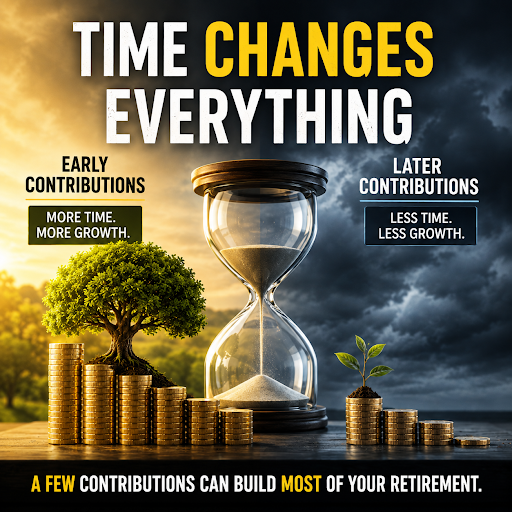
Only a Few 401(k) Contributions Build Most of Your Retirement
FAQs
What is compounding?
Compounding is the process of generating earnings on an asset’s reinvested earnings. In other words, compounding refers to generating earnings from previous earnings.
How does compounding build wealth?
Compounding builds wealth by allowing an asset to generate earnings, which are then reinvested to generate their own earnings. Over time, this process can lead to exponential growth in the value of the asset.
What are some examples of compounding in action?
Examples of compounding include interest earned on a savings account, dividends reinvested in stocks, and capital gains reinvested in a mutual fund.
What are the key factors that affect compounding?
The key factors that affect compounding include the rate of return on the asset, the frequency of compounding, and the length of time the asset is allowed to compound.
Why is it important to start compounding early?
Starting to compound early allows for a longer time horizon for the asset to grow, which can result in significantly larger wealth accumulation compared to starting later. This is due to the power of compounding over time.